
Italy Food Tours: What They Do Well and Where They Stop
Italy food tours are 2 to 4 hour tasting walks: a guide, 5 or 6 stops, roughly 44 to 109 euro in Rome, Florence and Bologna. For a first visit to a city they are the right buy for most people. They stay inside the city, though, so they rarely reach the people who make the food.
What is a food tour in Italy?
A food tour in Italy is a guided tasting walk of 2 to 4 hours, with 5 or 6 stops inside one walkable district and a small group. The format looks the same in every Italian city, and it settled there for good reasons.
It fixes a real problem. Say you have 3 days in Rome and no idea which of the 40 restaurants on a given street is any good. Somebody who eats there every week can walk you past 35 of them. That is worth paying for, and worth more on day 1 of a trip than on day 3, because the recommendations carry into every meal after.
The stops are shops, markets, counters and bars. Now and then one is a sit-down course. The Trastevere tour that includes a real meal is €79 and puts it in its title, which is a useful sign. If a listing's title leaves the meal out, assume there isn't one.
Geography is where it stops. A Rome food tour or a Bologna food tour is a walking product, so it happens inside the city it is sold in. The people making Parmigiano-Reggiano work 40 minutes outside Bologna, in a dairy that opens at 06:00.
How to choose a food tour in Italy: ask why that stop
Before you book a food tour anywhere in Italy, ask the operator one question (and ask us the same one): why that stop, and not the one next door?
Every operator has an answer. Plenty are operational: it is 40 meters from the last stop. There is a back room that fits 12 people. It is open at 16:00 on a Tuesday in February. The margin works at a 47 euro ticket. None of that is disgraceful, because a 3-hour walking tour at 47 euro has to clear a route that works 300 days a year.
We can't tell you any particular operator's answer, since websites don't show it and we would only be guessing. Ask them. The good ones answer straight away.
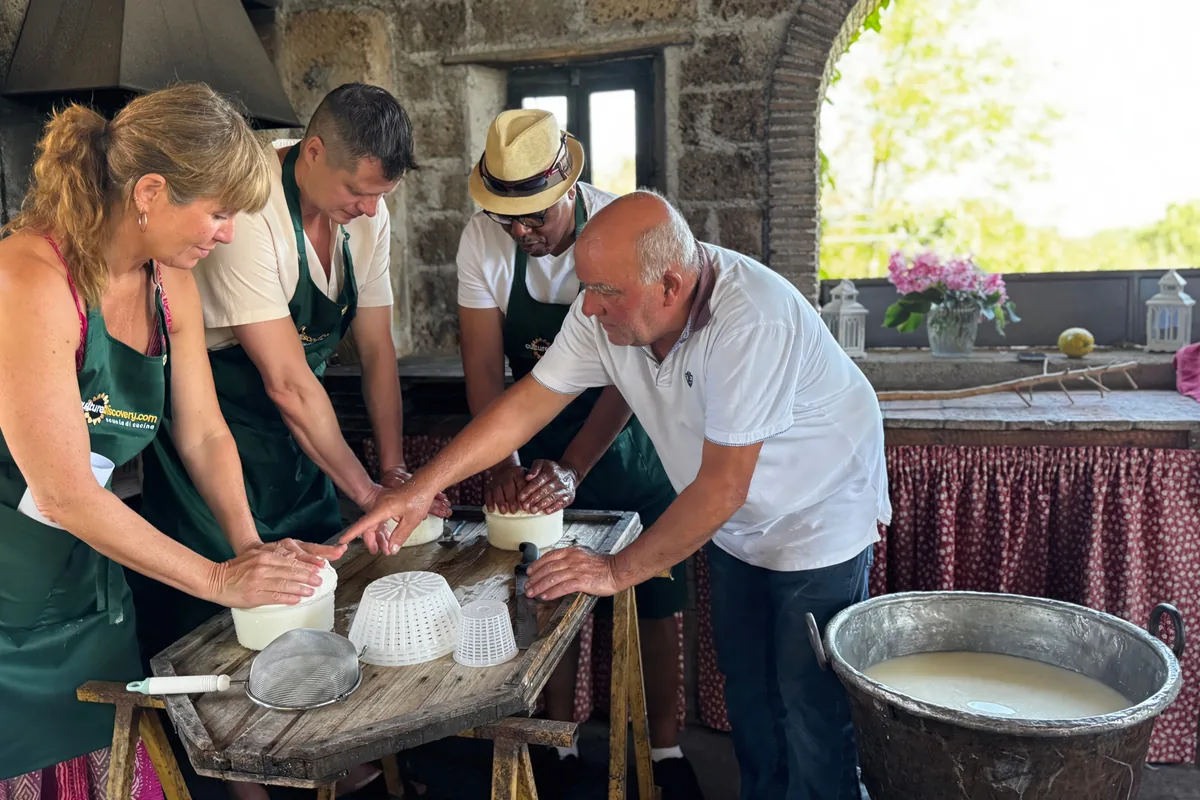
Ours has to be specific, because the answer is the whole product. Culture Discovery Vacations (CDV) goes to Roberto in Montalcino, Tuscany because it is Roberto: about 6,000 bottles of Brunello a year, a manual press, no advertising budget (which is also why the wine costs what it does). We hunt truffles at Montà d'Alba with Martina or her sister Vittoria, who raised those dogs. In Bologna the acetaia and the prosciutto producer are family-run, and we go to those 2 because we know those families. Neither is the closest to the ring road. On the Sicily week, guests make arancini with Antonio's family and then eat dinner in a local home.
Anyone can write "local family-run producers." Ask which family, what they make, how much of it, and what happens if you go back next year. An operator who picked the stop on margin can't answer, because they never had to know.
You can check one thing yourself before booking on a marketplace. Viator's category pages print the line "Revenue may affect this sort order" on the page itself. That line is about the order tours are listed in and says nothing about how any operator picks its stops. It does explain why the first screen of results can look so alike.
How much do food tours in Italy cost? Rome, Florence and Bologna
City food tours in Italy cost €44 to €109 in Rome, €45 to €99 in Florence and €60 to €179 in Bologna. We read those figures off the Viator category page for each city on 16 August 2026, as printed.
| City | Food tours listed | Lowest price | Highest price | Typical length |
|---|---|---|---|---|
| Rome | 500+ | €44 | €109 | 2 hours 30 minutes to 4 hours |
| Florence | 600+ | €45 | €99 | 2 hours 30 minutes to 4 hours |
| Bologna | 82 | €60 | €179 | 2 hours to 3 hours 30 minutes |
Look at the second column. Bologna lists 82 food tours. Rome lists more than 500 and Florence more than 600. Bologna is the best eating city of the 3 by a wide margin, and it has the fewest tours, because the count follows tourist numbers. If you are deciding where in Italy to go for food, that gap tells you more than any price in the table.
Bologna's floor is higher too: €60 against €44 in Rome. Fewer operators chase fewer visitors there, so nobody is under much pressure to run a cheap 2-hour version.
Best for
- Your first 48 hours in a city, when the guide's recommendations are worth more than the tastings
- Anybody with 3 or 4 days in Rome, Florence or Venice who wants 1 excellent food experience
- Solo visitors. A group of 8 strangers eating together beats a table for 1
Not for
- Meeting a producer. A 3-hour walking tour can't leave the city and get back
- Cooking. That is a different purchase, and it starts around 25 euro
- Dinner. Most of these are tastings, and the ones with a meal cost €79 and up
The Bologna producer day: a full-day food tour
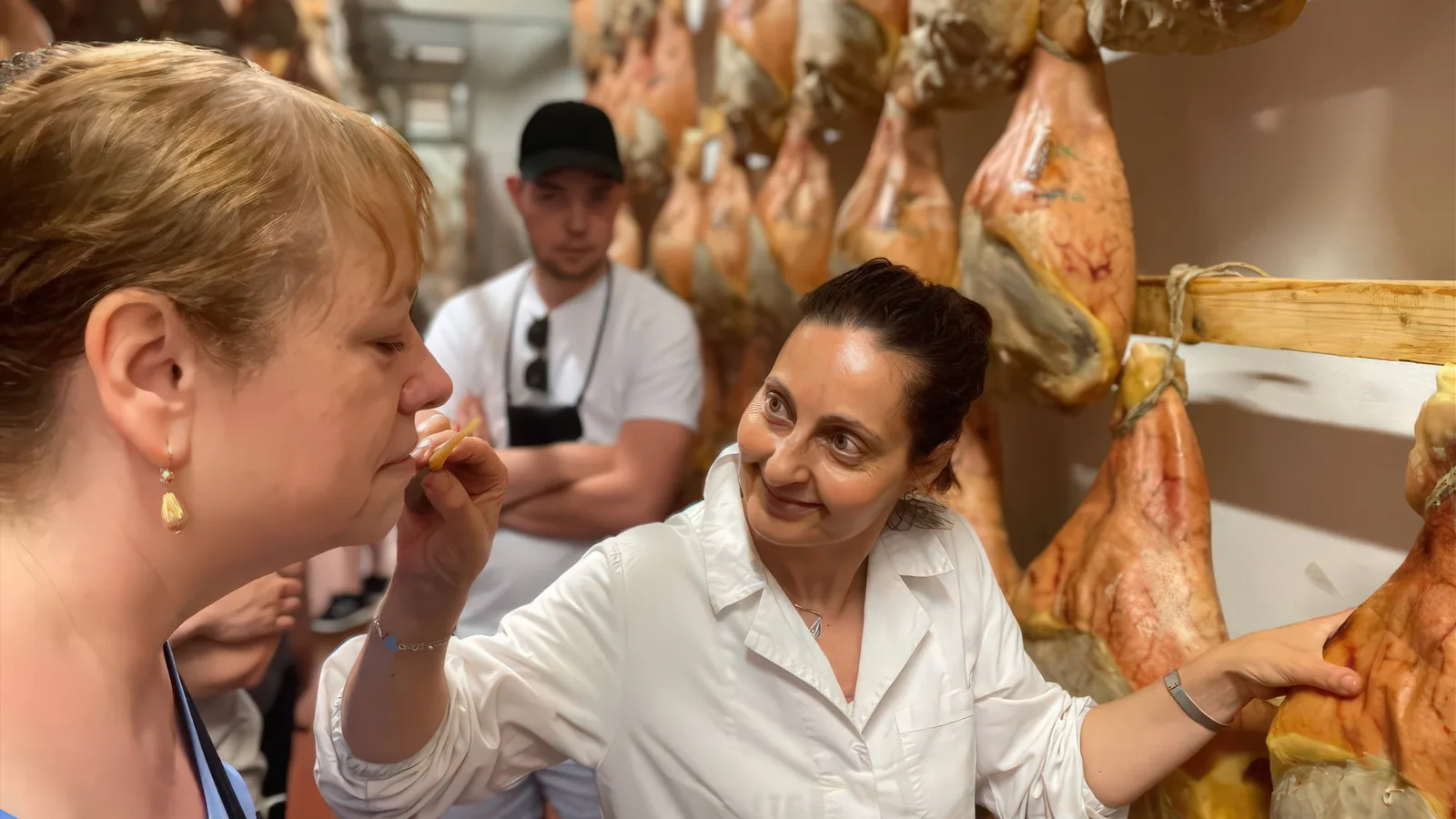
Out of 3 cities and hundreds of listings, we found 1 tour that does what a food-led week does: a 9-hour day out of Bologna for €179. It visits Parmigiano-Reggiano, Modena balsamic and prosciutto producers and includes a multi-course lunch with wine pairings.
That is roughly 3 times the city walking tours in the same city. Fair enough. Getting 12 people to a dairy at 07:00, then a balsamic loft, then a prosciutto aging room, then a proper lunch, is a different operation from walking Trastevere for 3 hours.
It is still a tour, and its own description uses factory-tour language, which is accurate. You will see how balsamic is made, and you will go home knowing a fair amount about balsamic.
Our day 5 in Bologna goes to a family-run acetaia and a family-run prosciutto producer at their own facility, and day 6 ends with a family dinner with locals. Those are the words on our own itinerary. The vinegar is excellent in both places. The difference is why you are standing there. We chose that acetaia because of that family, we have been going for years, and you are inside their working building instead of on a scheduled visitor slot. Guests book for the vinegar and come home talking about the family.
Hold that €179 next to what a culinary trip to Italy costs. A standard 8-day week with us is $849 a day, and that day includes the producers, the transport, 3 meals, the admissions and the tips. Seen that way, €179 is a fair price for one day of one component. If 1 day is all you want, buy it.
Food and wine tours of Italy: what a week does differently
A food and wine week in Italy changes where you sleep, how long you get with each producer, and who you eat with for 8 days. Only the second is about food.
If you want to know why we run the week the way we do, what sets Culture Discovery apart is the short answer.
You stop moving. The Northern Italy, Bologna and Venice week puts you in a private room at the Hotel Commercianti in Bologna for all 7 nights and drives out from there to Modena, Reggio Emilia, Maranello and Savigno. A food tour has to hand you back to your own hotel by 21:00, and your hotel is a cost it never carries.
You go back. A tasting walk gives you 20 minutes with a producer, if it gives you any. A week gives you 4 hours and a second visit. People tell you different things at hour 3 than at minute 15, and that is most of the reason to go. On the Tuscany, Chianti and Florence week that means Roberto in Montalcino, who makes about 6,000 bottles of Brunello a year on a manual press, putting guests in the rows with him during the September harvest.
The group stays the same. 12 to 18 people for 8 days, capped at 16 on most Trips and 18 on a few. On a food tour the group breaks up at the end, which is fine. Three hours is too short to mind.
A week is slower and far less efficient to buy than a food tour, because what you are paying for is time with people who live there. That time is why 42% of our guests come back instead of trying somewhere new.
Bologna & Venice, 2027
- 7 nights in a private room at the Hotel Commercianti in Bologna
- 4 full hands-on classes, the most of any Italy week we run
- 20 planned meals, wine at lunch and dinner
- Modena, Reggio Emilia, Maranello and Savigno
- Both transfers
- All external tipping; the one tip we accept is for your host
Per person on a double-occupancy basis, airfare not included. 6 departures scheduled for 2027 when we read the calendar on 17 November 2026. Every figure traces to config/pricing.json.
Whether that beats 4 food tours in 4 cities depends on what you are after, and plenty of people should buy the 4 food tours. They will see more of Italy than our guests do.
The rest of how these weeks differ is on how to choose an Italy culinary trip. The class question is its own trap, covered in cooking class or cooking vacation in Italy.
Where this isn't the right fit
With a long weekend in Rome, CDV is the wrong company: we have no Rome Trip and nothing shorter than 8 days, and a 47 euro food tour on your first evening will do more for your trip.
This is not what we do
If you have 3 days in Rome, book a food tour and skip the rest.
Culture Discovery Vacations does not run food tours, does not operate in Rome, and its shortest Italy Trip is 8 days. With a long weekend in Rome, spend about 47 euro on a Trastevere walk your first evening and eat well for the rest of the trip on what the guide tells you. It is the best-value food purchase in Italy, and we don't sell it.
Where to look instead
- A street food walk in Trastevere or the Jewish Ghetto for your first evening in Rome, from about 44 euro
- A Bologna market tour if you are in Emilia-Romagna, where 82 listings means less choice but a better hit rate
- The 9-hour Bologna producer day at 179 euro, if you want the Parmigiano dairy and the balsamic loft and only have 1 day for it
We have a gap of our own here. A CDV week visits fewer restaurants than a food-tour guest will, because we cook 2 to 4 of the meals ourselves and eat several more at the same table each night. If your goal is to eat in as many good places as possible, we are the wrong shape.
FAQs
How much does a food tour in Italy cost?
A city food tour in Italy costs roughly 44 to 109 euro per person in Rome, Florence or Bologna, read off the listings in August 2026. Street food formats sit at the bottom of that range and run 2 to 2 hours 30 minutes. Tours with a sit-down meal start around 79 euro. A full-day producer tour out of Bologna runs 179 euro for 9 hours.
How long is a typical Italian food tour?
A typical Italian food tour lasts 2 to 4 hours, and 2 hours 30 minutes is the most common length in Rome, Florence and Bologna. That covers 5 or 6 stops inside one walkable district. Anything sold as a full-day food experience is usually a producer tour that leaves the city by vehicle; those run 8 to 9 hours and cost roughly triple.
Is a food tour in Rome worth it?
Yes, on a first visit to Rome, and book it for your first evening. Rome has more than 500 food tours listed from about 44 euro, and the value sits in the guide's recommendations, which shape every meal you eat afterward. It is poor value if you already know the city, or if what you want is to meet producers or cook.
What is the best food tour in Italy?
The best food tours in Italy are in Bologna, which has the best food and the fewest tours: 82 listings against more than 500 in Rome and more than 600 in Florence. Fewer operators chasing fewer visitors tends to mean a better hit rate and a higher floor price, near 60 euro instead of 44. Rome has the most competition and the widest spread in quality.
What is the difference between a food tour and a culinary vacation?
A food tour is a 2 to 4 hour tasting walk inside one city, costing under 110 euro. A culinary vacation lasts 8 days or more, with accommodation, transport, most meals and producer access built in. Culture Discovery Vacations runs 8-day Italy weeks at $6,795 per guest, double occupancy, airfare excluded, which works out at $849 a day, and cooking is one thread of the week.
Do food tours in Italy include a full meal?
Usually not. The standard Italian food tour serves tastings across 5 or 6 stops, which adds up to a lot of food without being a structured meal. Listings that do include a sit-down course tend to say so in the title and price from about 79 euro. Look for the words "dinner" or "full meal" in the listing before you assume.
Can I visit Parmigiano-Reggiano and balsamic producers on a food tour?
Yes, on a full-day tour, but a city walking tour cannot reach them, because the producers are outside Bologna. Full-day tours run about 179 euro for 9 hours and cover a dairy, a balsamic loft and a prosciutto producer with lunch. The Culture Discovery Vacations Bologna and Venice week visits Modena and Reggio Emilia across 8 days.
Are there food and wine tours of Italy that last a week?
Yes. Culture Discovery Vacations runs 8-day food and wine Trips in Italy for groups capped at 16 on most departures. The Northern Italy, Bologna and Venice week includes wine at lunch and dinner, and the Tuscany, Chianti and Florence week visits Roberto in Montalcino, who makes about 6,000 bottles of Brunello a year. The Bologna week is $6,995 per guest, double occupancy, airfare excluded.
Does Culture Discovery Vacations run food tours?
No. Culture Discovery Vacations (CDV) sells 8-day and 12-day Trips and nothing shorter, based in Bologna, Radda in Chianti, Soriano nel Cimino, Canale and Amalfi, not in Rome, Florence or Venice. Anyone wanting a 3-hour walk in an Italian city should book one on a marketplace, where hundreds are listed with enough reviews to judge them properly.

-
Back to
-
Next question