

By Michael Kovnick, Founder • Updated November 28, 2026
Italy culinary vacations take you into the whole food world of a region. You shop the market with locals. You make cheese with a shepherd, pick olives, and eat lunch in a vineyard with the family who made the wine. Then you sit down to dinner with people who have cooked the same dishes all their lives. And yes, there are hands-on cooking classes too.
We have run culinary tours to Italy since 2006, in six regions: Soriano nel Cimino on the border of Tuscany and Umbria, Chianti, Piedmont, Emilia-Romagna, Sicily and the Amalfi Coast. A group is usually about 12 people. Seven trips last 8 days; Sicily takes 12. Your room, the classes, the visits and every planned meal with wine come in one price.
Ask ten people what a culinary trip to Italy should be, and you'll get ten answers. Most of them start with a cooking class. That's a fine start. But in Italy, the plate in front of you is the last page of a long story.
The story starts in a barn where the milk is still warm. It moves to a market stall, where the woman selling tomatoes tells you which ones are good today. It passes through a cellar, a bakery and an olive mill. And it ends at a long table, with someone's nonna making sure you had seconds.
That's what we mean by Italy culinary vacations. We want you to meet the people behind the food, all of them, and then cook with them. The classes are a big part of every week. They're one part, though, and the people around them are the rest.
Paola and I started Culture Discovery in 2006. Our first home in Italy is Soriano nel Cimino, where her family's old farmhouse is now our cooking villa. Since then, local friends have opened their kitchens, farms and cellars to us in five more regions. On this page I'll show you what you eat, make and drink in each one. I'll also give you the questions I'd ask before booking any culinary tour, ours included.
What Is a Culinary Vacation in Italy?
People use four names for food trips to Italy. They sound alike, but they are very different things. Here is how they compare.
| A cooking class | A food tour | A cooking school | Our culinary vacations | |
|---|---|---|---|---|
| How long | 3 or 4 hours | A few hours on foot | Days or weeks of lessons | 8 days, or 12 in Sicily |
| What you do | Cook a few dishes, then eat them | Taste snacks in shops around one city | Study technique in a teaching kitchen | Markets, farms, cheesemakers, olive mills, wineries and festivals, plus hands-on classes |
| Who teaches | A chef or a host | A guide | Chef instructors | Home cooks, farmers, winemakers and chefs we know by name |
| Meals | The one you cook | Bites along the way | Often the lunch you cook | Every planned meal, with wine |
| Where you sleep | Up to you | Up to you | Often up to you | One home base for the week (Sicily uses three) |
| Best for | A free afternoon in a city | A first taste of a city | Cooks who want a new skill | People who want to live the food of a region |
A cooking class is one great afternoon. A culinary vacation is a whole week of them, with the farms, the families and the long dinners around it. That is culinary travel in Italy, the way we do it.
If cooking is what you came for, our Italy cooking vacations page goes deep on the classes. If you want a short walk through a city's food shops, read about food tours of Italy. And if a school sounds right, see how cooking schools in Italy compare.
The Best Culinary Tours in Italy: How to Pick One
Search for the best culinary tours of Italy and you'll find long lists. Lists are fine. But two trips that look the same on paper can feel nothing alike once you're there. These are the questions I'd ask any company, us included. Ask them on the phone, and listen for clear answers.
1Who cooks with you?
A hired chef in a hotel kitchen, or a home cook in her own kitchen? Both can be fun. Only one feels like family. Our answer: home cooks, farmers and a few chefs we have known for years. In Piedmont, Marina and her daughter Monica teach in their own home, right at the family winery.
2How many people are in the group?
A big group can't fit in a farmhouse kitchen or a cheesemaker's barn. Our answer: about 12 guests, and never more than 16 or 18.
3What is in the price, line by line?
Ask about wine, tips, entry fees and dinners. Those are the costs that sneak up on you. Our answer: your room, the classes, every planned meal with wine, the tastings, the excursions, entry fees and tips. Flights and shopping are yours.
4Are the meals really included?
Some trips cover breakfast and the class lunch, then leave you to find dinner. Our answer: 20 planned meals on our 8-day trips, and 33 in Sicily. Wine comes with every planned lunch and dinner.
5How many hotels will you sleep in?
Packing a suitcase every other morning eats up a vacation. Our answer: one home base for the whole week on seven of our eight Italy trips. Sicily uses three, because the island is big.
6Who is with you all week?
A driver who drops you at the door is not a host. Our answer: a CDV host is with the group all week, and our local friends join us along the way.
7Is the cooking hands-on?
Watching a chef is a show. Rolling the pasta yourself is a skill you take home. Our answer: every class is hands-on, and you cook as much or as little as you like.
8What fills the rest of the day?
Food lives far outside the kitchen. Our answer: markets, mills, cheese farms, wineries, a truffle hunt in Piedmont and a medieval festival in October.
There is no one best culinary vacation in Italy. There's the best one for you. If wine is your thing, look at Piedmont. If you want to feel like you live in a village, come to Soriano. If you want the most variety, Sicily has it. If you want a list to start from, we wrote up the 10 best food and wine vacations in Italy.
Love the wine as much as the food? Our food and wine tours of Italy page follows the glass, winery by winery.
A Culinary Map of Italy, Region by Region
Every region eats in its own way. The cheese changes, the bread changes, even the shape of the pasta changes. Here is what you eat, make and drink on each of our Italy culinary tours.
Soriano: Our Village and Our Kitchen
Soriano nel Cimino sits on the border of Tuscany and Umbria. It's our first home in Italy, and it's the week where you'll feel most like a local. You sleep in a home in the village. Breakfast is a cappuccino and a pastry at Caffè Roma in the piazza, next to people on their way to work. On the first afternoon, Carla shops the local markets for the week. It's included, so come along if you like.
We cook at Villa Eddarella, the old farmhouse Paola's family built. One morning a local shepherd comes to help us make fresh ricotta. We have lunch at Madonna delle Macchie, a family wine and olive oil estate in Castiglione in Teverina. The owners cook for us with their own oil and pour their own wine. On the last night we fire up the wood oven for pizza, and make limoncello cream too.
In October, two more Soriano trips add something special. On our festival weeks, the whole town turns medieval for the Chestnut Festival, and we eat in the taverns run by its four old neighborhoods. On our olive harvest week, we pick olives, press them at the mill and fill a tin with our own oil. More on the Soriano weeks, between Tuscany and Umbria.
- Eat: pici all'aglione, saltimbocca, a flight of aged pecorino in Pienza
- Make: ricotta, ravioli, tiramisù and wood-fired pizza
- Drink: Brunello at La Piombaia, Vino Nobile at De Ricci, Orvieto wine at the mill
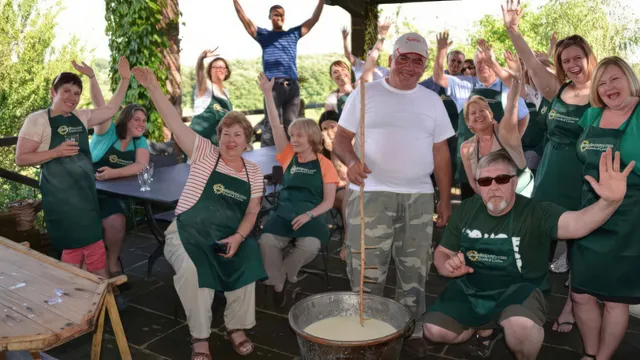
Cheers all around after making fresh cheese in Soriano.
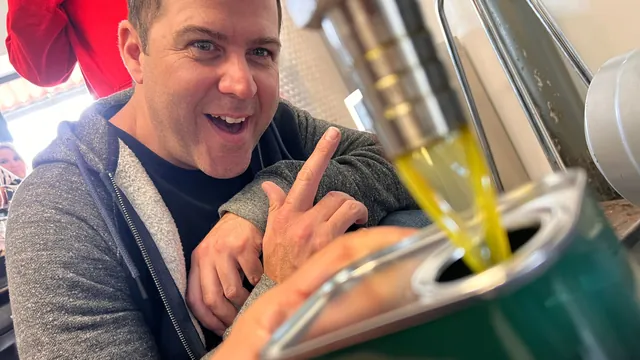
Filling a tin with oil from olives we picked that morning.
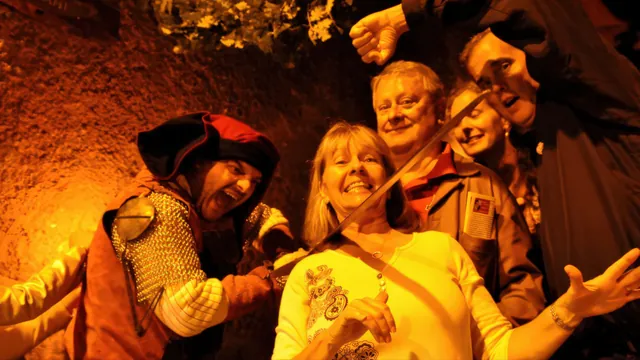
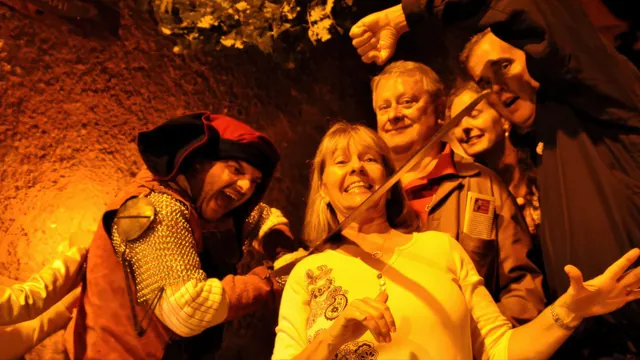
Festival week: our guests with a swordsman of Soriano.
Chianti: Goat Cheese, Beans and a Steak on the Grill
Our Chianti week is based at Palazzo Leopoldo in Radda in Chianti. Two classes are in town, where we make gnudi with butter and sage, ossobuco and almond cantucci. The third takes us to a farm near Cortona. Patrizia and her family grow beans there. We make gnocchi and her chicken cacciatora, then eat it all at her table.
The rest of the week, we meet the people behind the food. Marta is a young woman from Chianti with her own goat farm, and she shows us how she makes her cheese. Lunch is at her father's winery. In Pienza we taste a flight of aged pecorino. Near Greve, Simone's family raises Chianina cattle at Castellinuzza. We fire up their wood oven for schiacciata, a local pizza, and then the steak comes off the grill.
See the Chianti and Florence week, or our Tuscany cooking vacations page.
- Eat: bistecca fiorentina, gnudi, pecorino from Pienza
- Make: gnocchi, lasagna with Tuscan ragù, Caprese cake
- Drink: Chianti Classico, Brunello and Vino Nobile, with a sommelier class on day two
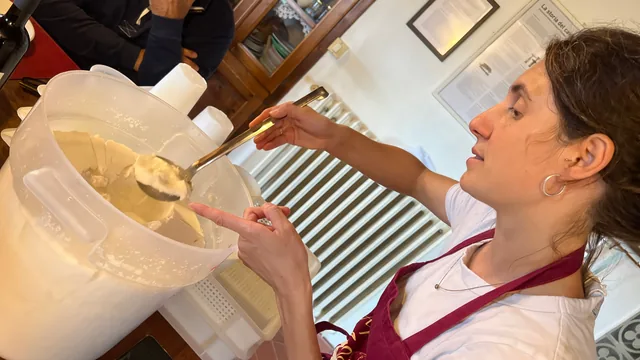
Marta makes goat cheese on her farm in Chianti.
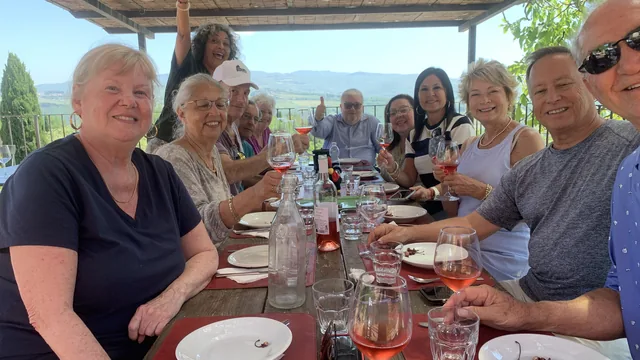
A toast at lunch with a winemaking family in Chianti.
Piedmont: Truffle Dogs, Alpine Cheese and Barolo
We stay at Villa Cornarea in Canale, in the Roero hills. Before one class we walk the Canale market to buy what we need. Then Marina and her daughter Monica teach us in their family home at the Marsaglia winery. We make ragù lasagna, potato gnocchi with Castelmagno, and a chocolate roll they call salame del Papa.
Castelmagno is a cheese from the Alps, so we drive up to meet the people who make it. Another morning we go out with truffle hunters and their dogs to look for black truffles, then have lunch with the hunters. In Torino we walk from a bakery that makes grissini to a master chocolatier, sip a bicerin in an old café, and make our own gelato. One night is a farm-to-table dinner at Agriturismo Bajaj with Adriano and his family.
Read about the Barolo week, or see our Piedmont and Barolo page.
- Eat: gnocchi with Castelmagno, farinata, bicerin and gianduja
- Make: lasagna, gelato, and your own bottle of perfume at the villa
- Drink: Barolo with Alberto at Ballarin, Barbera from Fabrizio, Arneis at the villa
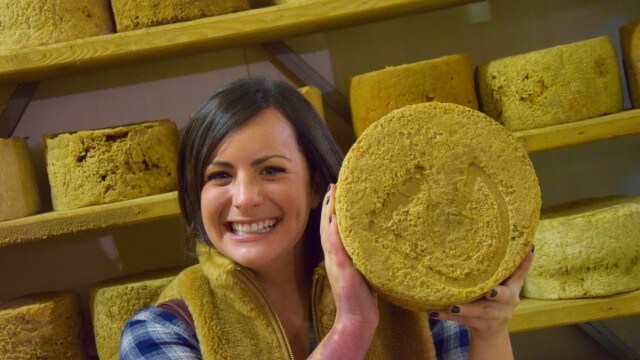
A wheel of Castelmagno, the cheese of the Piedmont Alps.
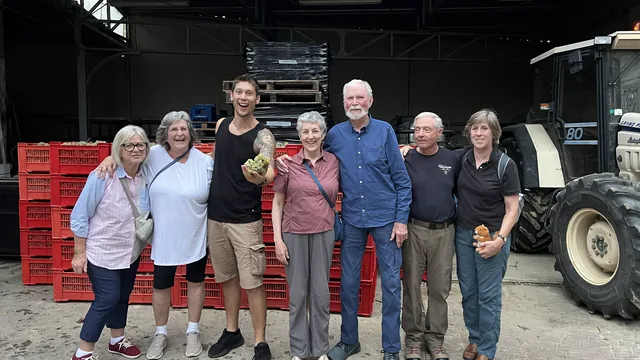
Smiles with a young farmer at Agriturismo Bajaj.
Can you smell the bread yet? Have a look at the dates. Or write to us and ask anything at all. A real person on our team will write back.
See dates and prices Talk to usBologna: Parmigiano, Balsamic and the Oldest Osteria
Our home for the week is the Art Hotel Commercianti, right in the middle of Bologna. Roberta, Ines and Giusy teach us at their family trattoria in the hills, Botteghino di Zocca. We make tigelle, green lasagna and zuppa inglese. On the last night, they show us how to fold tortellini. One class is at Ca' Matilde, where chef Andrea Incerti Vezzani has a Michelin star and walks us through his garden.
This is the region of makers. At a private estate in Cognento we turn milk into a wheel of Parmigiano with our own hands, then taste wheels from young to very old. Lorenzo's father began making balsamic vinegar more than 70 years ago, and we taste bottles aged 8 to 25 years before lunch at the family's acetaia. A tiny family prosciutto maker shows us how it's done. One evening we shop the old Quadrilatero market and carry our food into Osteria del Sole, open since 1465. You bring the food. They pour the wine.
There's a day in Venice too, with a visit to a gondola workshop. See the Bologna and Venice week, or our Bologna and Emilia-Romagna page.
- Eat: tigelle, tortellini, Parmigiano at different ages
- Make: Parmigiano by hand, green lasagna, tortellini
- Taste: balsamic aged up to 25 years, and prosciutto from a small family maker
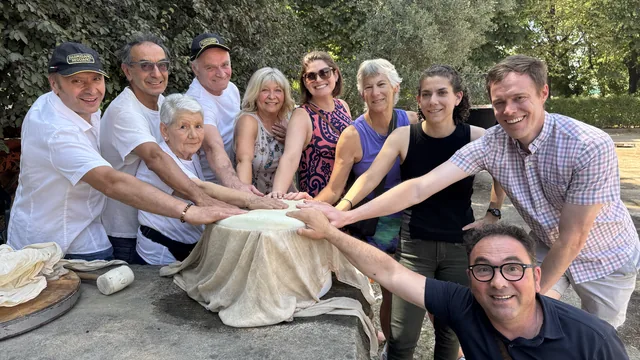
Making Parmigiano by hand near Modena.
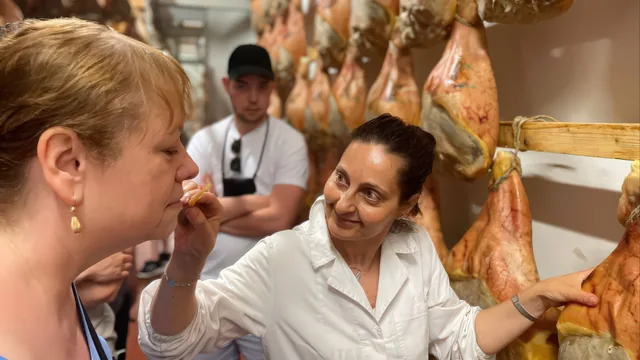
Tasting prosciutto at a small family producer in Savignano sul Panaro.
Sicily: Twelve Days of Markets, Pistachios and Cannoli
Sicily gets 12 days, and it needs them. We start in Taormina, ride up Mount Etna and eat lunch at a winery on the volcano. In Catania we walk the fish market. Near Bronte, Antonio and his family show us their pistachio farm, and we learn to make arancini.
In Scicli we live in an old palazzo. Gabriella and her husband Luca cook with us at their country villa. In Modica, Elisa shows us how the town makes its old-style chocolate. At Masseria Sgarlata, the master cheesemaker Albino teaches us to make provola by hand.
Then we cross the island to Menfi and a country villa that is ours alone, owned by the Planeta wine family. We cook busiate with Trapani pesto and cannoli at their Ulmo winery. We make sausages with Francesco Campo, a local butcher, and see the salt flats near Marsala. The last full day is Palermo, where lunch is street food at the Capo market. Read the Sicily trip, or our Sicily page.
- Eat: arancini, cassatelle with ricotta, Palermo street food
- Make: provola, scaccia, sausages, Modica chocolate
- Drink: Etna wines on the volcano, Planeta wines at La Foresteria
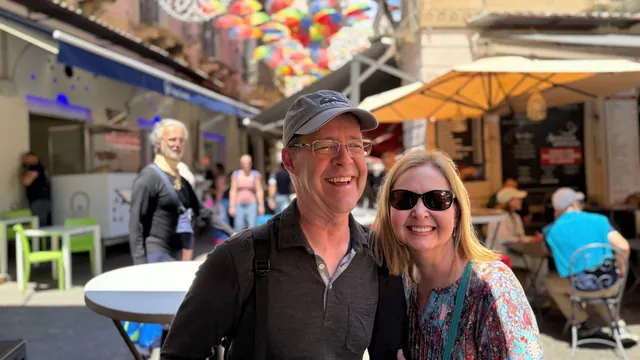
Big smiles at the market in Catania.
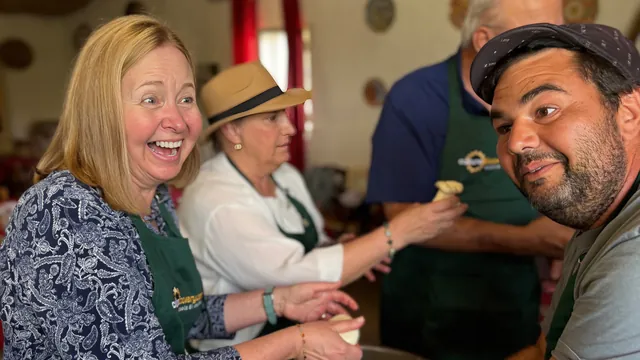
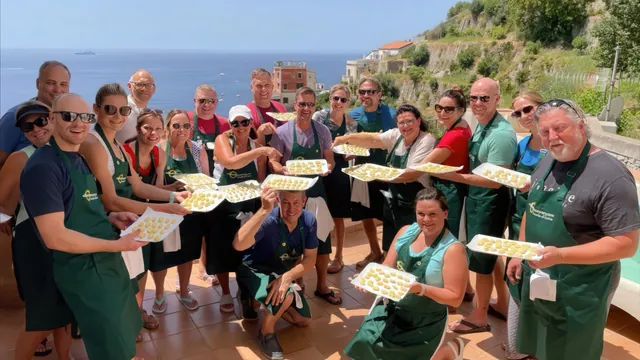
Laughing through a cheese class in Sicily.
Amalfi Coast: Lemons, Mozzarella and Very Old Vines
We stay at a villa above the sea and cook in its kitchen: scialatielli with ragù, meatballs, and a babà soaked in rum. One night Peppe and Tonino run a Neapolitan pizza night, with homemade gelato after.
In Ravello, Biagio lets us make our own mozzarella in his cheese shop. In Minori we shop the weekly market and make limoncello at Carletto's small factory. Lunch that day is from Salvatore De Riso, one of Italy's best-known pastry chefs. High in the hills of Tramonti, Raffaele and his family pour their wine beside some of the oldest vines in Europe. The last dinner is built around Amalfi lemons, and we cook it together at the villa.
See the Amalfi Coast week, or our Amalfi Coast page.
- Eat: ravioli with lemon, pasta e fagioli, lemon cake
- Make: mozzarella, limoncello, Neapolitan pizza
- Drink: Tramonti wine at the winery, Prosecco at sunset off Positano
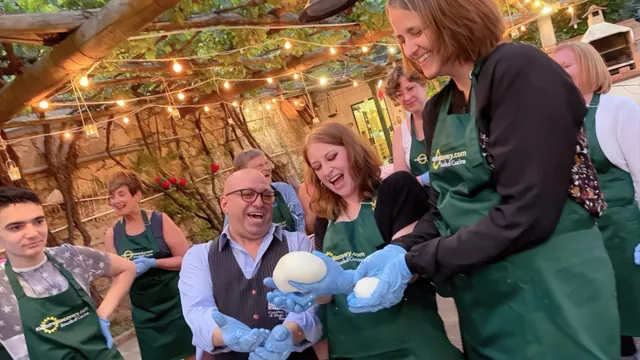
Making mozzarella with Biagio in Ravello.
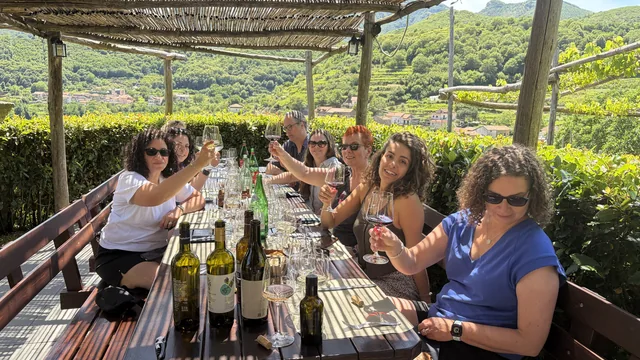
Lunch under the pergola at the winery in Tramonti.
A Day on One of Our Italy Culinary Vacations
What does a day feel like? Here's a Tuesday on our Soriano week. Times move a little from week to week.
- MorningCappuccino and a pastry at Caffè Roma, in the piazza, side by side with the locals before they head to work.
- 9:30We drive out to Villa Eddarella and put on our aprons. A local shepherd joins us, and we make fresh cheese and ricotta with him.
- ClassBruschetta with stracchino, pancetta and rosemary. Pici all'aglione, thick hand-rolled pasta in a garlic and tomato sauce. Saltimbocca alla Romana, spinach, and tiramisù.
- LunchWe sit down and eat all of it, with a glass from the villa's wine rack.
- 3:30Back to the village to rest. Some people nap. Some people walk. Nobody is hungry.
- 5:30Viterbo, the City of Popes. Fountains, the medieval quarter and the Papal Palace, then time for gelato or an aperitivo.
- 7:45Dinner in Katia's private family tavern. Katia teaches some of our classes, too, so it feels like eating at a friend's house. Because it is.
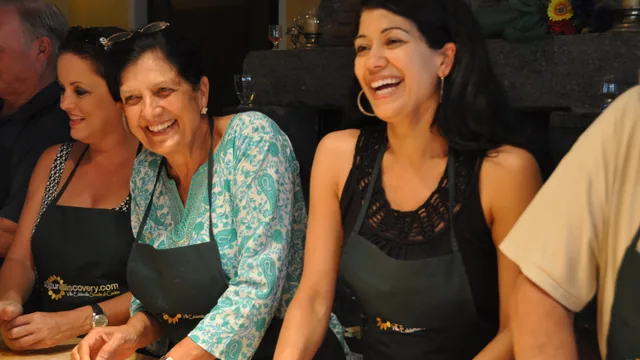
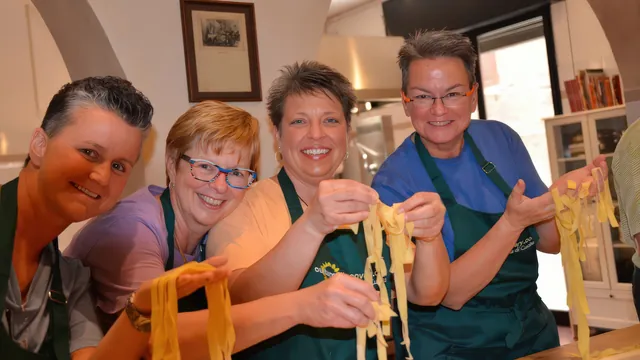
Laughing through class at Villa Eddarella in Soriano.
What Is Included on Our Italy Culinary Vacations
This is what people ask about most when they compare Italian culinary tours, so here it is in plain words. One price covers:
- Your room for the whole week
- Every hands-on cooking class, at least three on every trip
- Every planned meal: 20 on our 8-day trips, 33 in Sicily
- Wine with every planned lunch and dinner
- The farm, cheese, mill and winery visits on the itinerary, with their tastings
- Excursions, entry fees and tips for local guides
- A CDV host with the group all week
What's left for you
- Your flights
- Your own shopping
- Drinks beyond the planned menus
Add it up and it's a lot. A week of long dinners with wine, private visits with cheesemakers and winemakers, and a host who knows everyone. Some of it you could never book on your own. On our olive harvest week, the mill lets you press your own olives and take home the oil. They do that only for our guests.
We spell out every line on what all-inclusive really means.
Our Italy Culinary Vacations for 2027
Eight weeks in six regions. All of them are small groups with hands-on classes, and the wine is always poured. Our Soriano weeks come first, because that's home. Prices come live from our booking system.
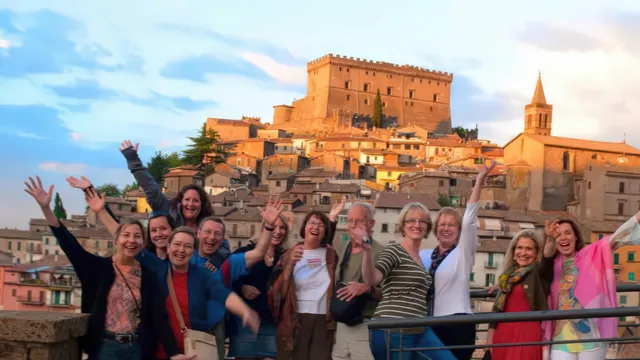
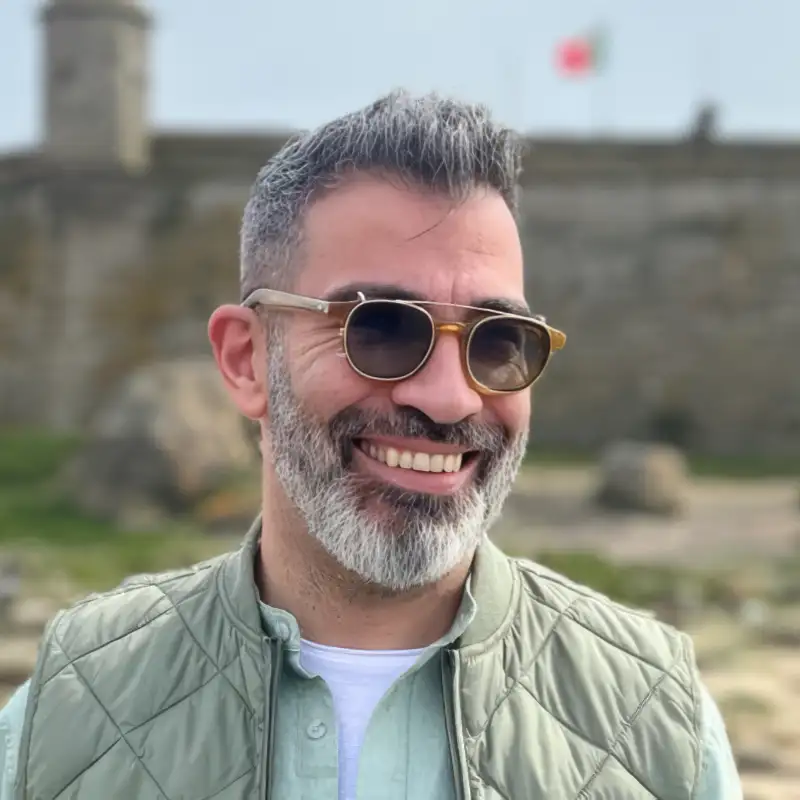
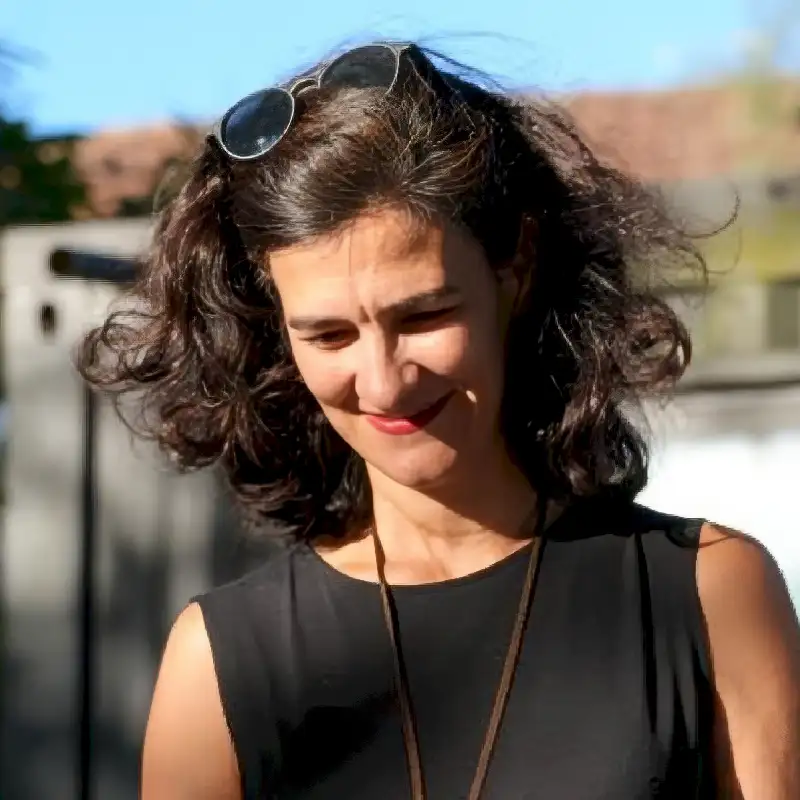
The people behind Culture Discovery
Michael & Paola Kovnick founded Culture Discovery Vacations in 2006. Paola was born in Soriano nel Cimino, the village in central Italy where many of our weeks are based. Michael first came to Italy in 1983. They run the company with their partners Daniele Pintaudi, our Global COO, whose career runs from Michelin-starred kitchens to a Relais & Châteaux property, and Marta Marques, who founded her own tour company and merged it with ours.
On the trip itself you are with our local hosts, home cooks and family winemakers: the people who make the week what it is.
2026 Travel Weekly Magellan Gold Award: Best Tour Operator, Overall · 2025 Magellan Gold Award for Best Service · Tripadvisor Hall of Fame
See dates and prices Talk to us
What our guests say about the food, and the people
5.0 out of 5 from 1,013 guest reviews of these trips
Best of all worlds!
“This experience was beyond anything I could have hoped for! Our guides, Camilia and Tomas were fabulous. They were helpful, fun, patient and really went above and beyond. Our bus drivers were terrific!”
Andrea S., Pewaukee, WI
· November 2026
Culinary Treasures of Bologna, Venice, Michelin Stars & Exotic Cars: all reviews
The Family Feeling is Real
“This tour is not the usual "big city and crowded museums" tour. We spent a few days before and after in Florence and Rome to "check the usual tourist boxes". What we found with CDV in Tuscany and Umbria was a fun family atmosphere with our lively and generous hosts.”
John G., Gaithersburg, MD
· November 2026
Wine & Cooking Under the Tuscan & Umbrian Sun: all reviews
CDV Excels Once Again!
“My wife and I went on the Amalfi tour last year. It was fabulous! We thought we'll try them again. We had high expectations based on our previous experience with CDV. Well those expectations were met and exceeded! The Barolo Wine country trip was just fantastic!!”
John M., Kenosha, WI
· November 2026
Wine, Cooking and Castles in Barolo & Roero: all reviews
Each review comes from one of our small groups. Why we keep them small is on our small group tours of Italy page. To see every week side by side, go to Italy cooking vacations. We cook outside Italy too: see our culinary tours of Europe, or our culinary tours of Spain.
When to Go: Harvests, Festivals and Market Seasons
Our Italy culinary tours run from April through October, and every month tastes a little different.
Spring. The gardens fill up and the markets turn green. Our first weeks of the year start in April, in Sicily, Chianti, Soriano and Bologna.
Summer. Long dinners outside, late light, and the sea on the Amalfi Coast warm enough to swim.
Grape harvest. The Tuscan grapes come in from about the middle of September to the middle of October. Some weeks, depending on the year, we end up in the rows with our winemaker friends.
Festival time. Italians call a town food festival a sagra. Soriano's Medieval Chestnut Festival has run for more than 50 years, on the first two weekends of October. Our two festival weeks are built around it. You eat polenta, grilled sausages and chestnut stew in the taverns, then watch the shows in the piazza at night.
Olive harvest. Our olive week comes in late October. We pick on the day with the best weather and move the other days around it. Our guide on when to go to Italy goes month by month.
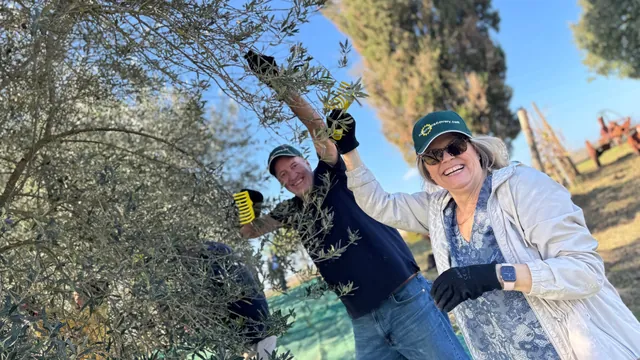
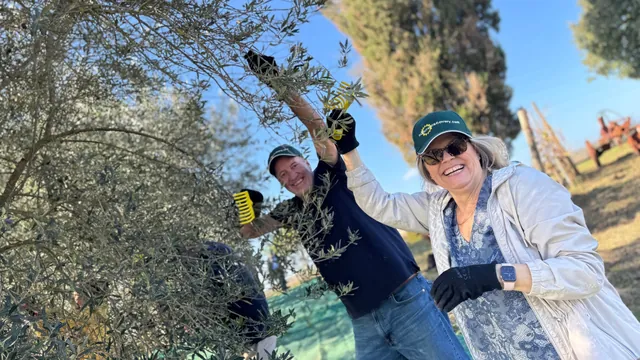
Picking olives on our late October week in Soriano.
Questions About Italy Culinary Vacations
What is the best culinary tour of Italy?
The best one is the one that fits what you love. Ask who cooks with you, how big the group is, what the price covers and how many hotels you will sleep in. For us, Soriano nel Cimino is the week that feels most like living in a village. Piedmont is the pick for wine lovers. Sicily has the most variety, over 12 days.
How much does a culinary trip to Italy cost?
Our 2027 Italy culinary vacations start from $6,095 per person, double occupancy. That buys 8 days and 7 nights on most trips, or 12 days in Sicily, with your room, the classes, all planned meals and their wine, the tastings, excursions, entry fees and tips. Flights and personal shopping are extra.
What is the difference between a culinary vacation and a cooking vacation in Italy?
A cooking vacation is built around classes. A culinary vacation in Italy takes in the whole food world around them: markets, farms, cheesemakers, olive mills, wineries and food festivals. Our trips do both. Every week has at least three hands-on classes, and the rest of the time we meet the people who grow and make the food.
Are Italy culinary tours good for people who don't cook?
Yes. Plenty of our guests come for the food and the people more than the cooking. In class you can cook as much or as little as you like. Pour a glass, help with one dish, or just watch and eat.
What is included in your Italy culinary vacations?
Your room for the week, every hands-on cooking class, every planned meal with wine, the farm, cheese and winery visits, the tastings, excursions, entry fees and tips for local guides. On our 8-day trips that adds up to 20 planned meals. Sicily has 33.
How big are the groups on your culinary tours to Italy?
Most weeks we sit about 12 guests at the table, and we never take more than 16 or 18. A group that size is what lets us cook in family kitchens and eat at family tables.
Which region of Italy is best for a culinary vacation?
Each one eats in its own way. Emilia-Romagna is the home of Parmigiano, balsamic vinegar and fresh egg pasta. Piedmont has truffles, Castelmagno cheese and Barolo. Sicily has street food, pistachios and cannoli. Soriano nel Cimino, on the border of Tuscany and Umbria, gives you village life, olive oil and the feel of home.
When is the best time for a culinary trip to Italy?
We cook in Italy from April to the end of October. Spring brings green gardens and full markets. Mid-September to mid-October is the grape harvest. Early October is the Medieval Chestnut Festival in Soriano, and late October is our olive harvest week, when you press your own oil.
Do your culinary tours of Italy include wine?
Yes, on every Italy trip. A glass is poured at each planned lunch and dinner, and the winery visits and tastings are part of the price. You only pay for drinks off the planned menus.
How many cooking classes are on your Italian culinary vacations?
Every trip has at least three hands-on classes. The Amalfi Coast week has four. Sicily has the most, with pasta, arancini, cannoli, sausages, chocolate and more.
Italy planning guides
Straight answers with real 2027 numbers, written by our team. Read them before you book with anyone, us included.
Pull up a chair at our table
Pick a region and a week, and we'll set a place for you. Questions first? Just ask. We'll write back.
See dates and prices Talk to us